by Holly Ramirez
Every year, the NFL hosts a halftime show during the Super Bowl to entertain the audience, but also to gain more viewership. The artist is selected based on their popularity level that year and who’s had the biggest hits. Those who watch the Super Bowl either watch it for the actual game and the teams that are playing, or are forced to watch it because of family members, so the halftime show is something that non-football fanatics tend to look forward to.
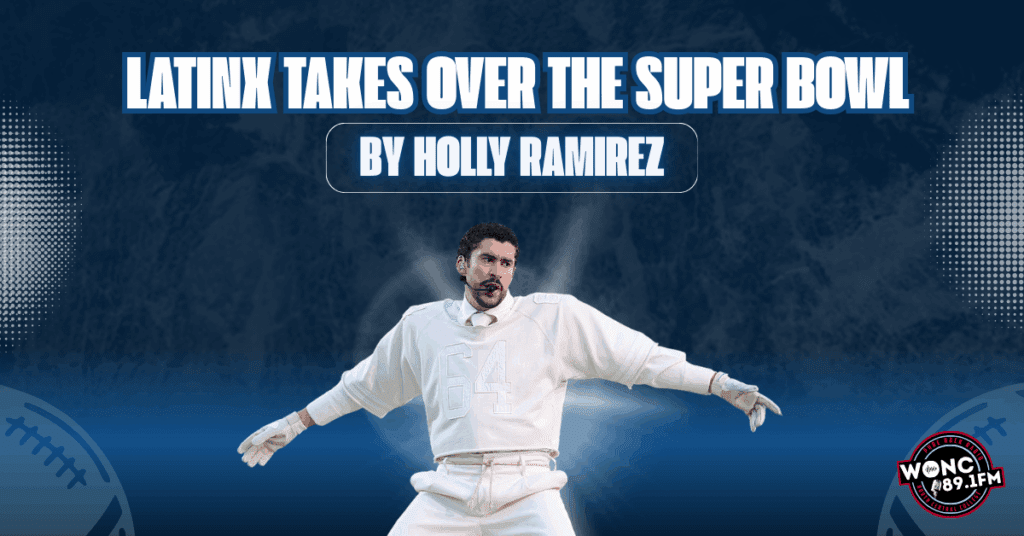
The NFL announced their halftime show performer pretty early in the season, and this year they announced that Bad Bunny would be the 60th Superbowl halftime show performer. There was a lot of controversy, however, from the public because many traditionalists were upset that the he is a Puerto Rican artist who makes music primarily in Spanish, and they believed that the show should be performed in English since it’s generally considered the “default language” in the U.S. The other side of the internet was fine with the selection because they believed it would be something cool, new and different, and language shouldn’t be a determining factor for who could perform. The Hispanic community was possibly the most excited group out of everyone after finding out the news because it gave them some hope and something to look forward to.
Both groups spent the entire season arguing over the topic and whether the NFL should switch out Bad Bunny with an artist who performs in English or to keep him, but he isn’t the first Latino to perform at the Super Bowl, and he likely won’t be the last. In 2020, Jennifer Lopez and Shakira were the performers for the halftime show, and they left a lot of people talking after their amazing performance. Before them, Gloria Estefan performed twice on the Super Bowl stage in the 90’s, so why was Bad Bunny receiving so much hate?
In 2025, the Bad Bunny announced tour dates, and along with the announcement, he mentioned that he wouldn’t perform in the U.S because of the circumstance the Hispanic community is currently in, and he didn’t want to put his fans in any danger. The opposing side believed that he hated the country and therefore shouldn’t be given the ability to perform on, debatably, the biggest stage in the country.
In the end, none of the hate was able to prevent Bad Bunny from taking over the halftime show stage, and he didn’t leave room for disappointment. As in previous years, many spectators had predictions on how the show would go, which songs the artist would perform, and who he would bring out on stage, but nothing could prepare us for what Bad Bunny would provide.
The show started off with showcasing hardworking Latinos in the fields cutting grass, which eventually turns into a pueblito. The camera focuses on Bad Bunny singing one of his most popular songs, “Titi Me Pregunto,” as he walks through the fields passing by common locations in a Hispanic community, almost like a Monopoly board. He captures a fruit cart, a group of old men playing dominoes, two women in a nail salon, a man behind the grill, two men boxing, and La Marqueta. He showcases the diversity of Latina beauty, and how connected the Hispanic community is.
The whole performance felt relatable and authentic to the audience; for example, the kid falling asleep on a chair at the wedding. Everyone on stage was singing and dancing, which is a huge part of the culture. Bad Bunny invited recognizable faces on stage such as Karol G, Pedro Pascal, Cardi B, and many more. He brought Lady Gaga in as a guest to sing, “Die with a Smile,” but with a touch of Salsa. Her whole outfit was inspired by the former flag of Puerto Rico, and Ricky Martin sang, “Lo que le paso a Hawaii.” Bad Bunny passed his Grammy award to a childhood version of himself to demonstrate that all dreams are possible. He ended his performance by stating, “God bless America,” before mentioning many countries that make up the Americas, along with the sentence, “The only thing more powerful than hate is love,” being showcased on the Jumbotron.
Overall, his performance was impactful and astonishing. After the show, people began to post their opinions on social media. Many spectators said that Bad Bunny’s show was beautiful, unique, and impactful. The Hispanic community mentioned that his performance accurately represented their culture both visually and vocally. Even some who were initially skeptical acknowledged the level of thought, symbolism, and pride woven into every moment of the performance. In the end, the halftime show wasn’t just entertainment, but a reminder that the Super Bowl stage is big enough to celebrate the many cultures and languages that shape America.