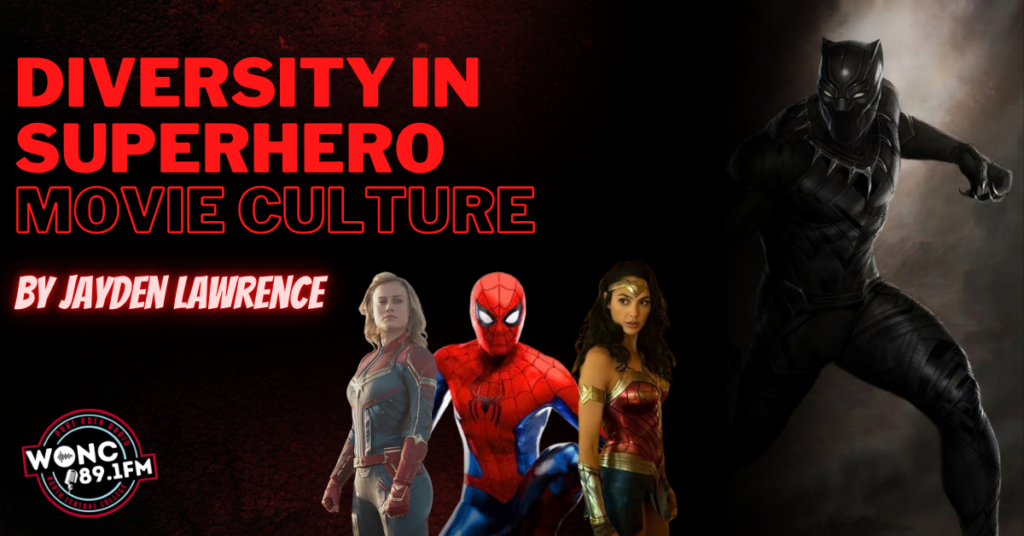
by Jayden Lawrence
As we all know, superhero films have dominated modern pop culture for more than a decade. Recently, whether it’s Spiderman, Black Panther or Shang-Chi, Marvel movies have forced people to engage in critical discussion. However, superhero success has historically depended on how studios respond to changing audiences. As I got more into movies, I began asking why the most successful superhero franchises still centered mostly on traditional leads in 2017, a time where diversity should have been the forefront of Hollywood.
Two studios stood at the center of this conversation: Marvel Studios and DC Studios as they led the superhero world. Marvel was the industry leader financially, but it moved slowly when it came to diverse lead characters. DC often attempted more visible diversity earlier with Harley Quinn, Deadshot and more, yet its films repeatedly struggled according to criticism because representation was not matched with stable planning or consistent quality. This is not to say queer heroes got their shine in the movie productions though, as a lot of diversity was still not allowed on the main screen in a lead role.
Characters like Iron Man, Captain America, Thor, and Doctor Strange each received solo films before women or Black heroes were given similar treatment. Although side characters from different backgrounds appeared throughout the franchise, major lead representation was delayed.
This issue became more noticeable because Marvel often presented itself as modern and forward thinking. Yet it was not until Black Panther that the studio released a Black led superhero film inside the MCU, and not until Captain Marvel that a woman received a solo lead film in the main franchise. Both movies became commercial successes, proving there had been a large audience for these stories all along. Black Panther especially became a cultural moment that resonated with me as a top movie all-time. Its success made me wonder why Marvel had waited so long to center a diverse lead.
Part of Marvel’s delay likely came from Hollywood’s old belief that films led by nontraditional leads were riskier investments, both domestically and internationally. Studios have often relied on outdated assumptions about what audiences will support. Marvel benefited from playing it safe early, but in doing so it missed opportunities to lead culturally as quickly as it led to better results financially.
While Marvel moved cautiously, DC had a different problem. DC often showed a willingness to cast more broadly or spotlight a wider range of heroes, but it lacked the consistent planning needed to make those efforts succeed. The modern DC film universe launched with major expectations but struggled with tone, leadership changes, and constant resets.
Although, also in 2017, films like Wonder Woman showed how successful representation could be when paired with strong execution. The movie was critically praised and commercially successful, proving audiences wanted female led superhero stories. Yet other projects stumbled because the larger universe lacked direction. Justice League films arrived before enough character development had occurred, making the narratives feel weak.
This created an unfair cycle in public discussion. When a diverse DC project failed, some people blamed representation itself rather than weak scripts, poor planning, or executive interference. Diversity became a scapegoat for deeper structural issues. In reality, audiences usually reject bad movies, not diverse casting. When films are compelling and well made, I truly believe viewers consistently support a broad range of characters.
The difference between Marvel and DC highlights two opposite mistakes. Marvel delayed representation too long because it prioritized caution. DC sometimes pushed representation into an unstable cinematic environment where even strong ideas were undermined by poor execution.
Honestly, in the broader sense, superhero movies reflect how entertainment industries respond to social change. Although viewers want to imagine themselves on screen, they also expect quality. Representation should never be treated as a marketing shield or a substitute for good storytelling. At the same time, studios should not use old myths about audience preferences to justify exclusion.
Marvel showed that diverse leads could have been successful sooner. DC showed that diversity alone cannot save a confused franchise. The future of true, respectable cinema belongs to studios that understand both truths. When representation is paired with strong stories, audiences usually reward it. And if either is missing, count me out from watching it.