by Jesse Hudgins
There are very few comics that I would consider to be some of the best comics I have ever read; Absolute Martian Manhunter is one of those comics.
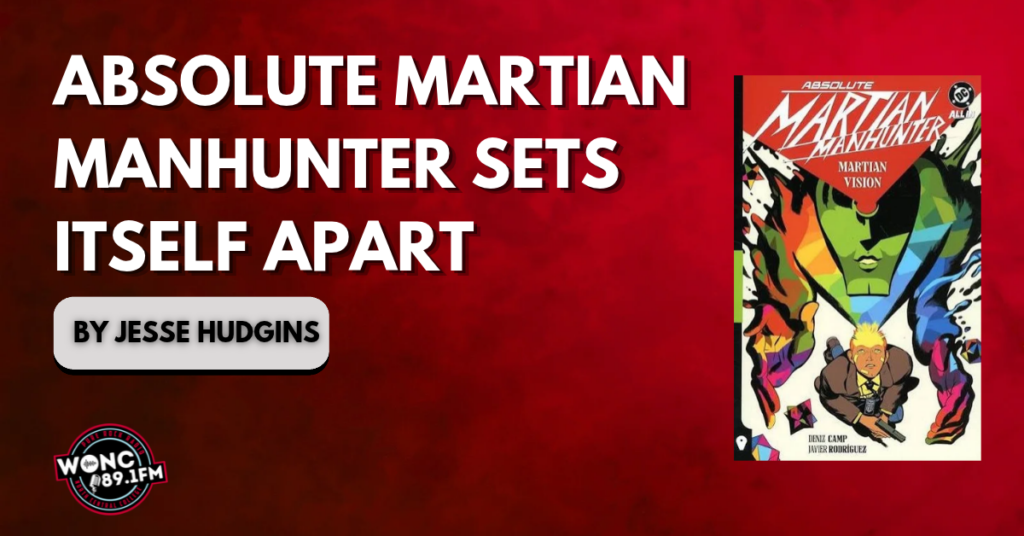
Debuting in March of 2025, Absolute Martian Manhunter is written by Deniz Camp and drawn by Javier Rodríguez. It was a part of the second wave of Absolute comics alongside Absolute Flash and Absolute Green Lantern. It was a limited series running for 12 issues. Even with it being a shorter series, it’s one that captures the audience’s heart and imagination.
The comic follows this universe’s version of John Jones, who’s an FBI agent having troubles at home with a divide growing between his wife, Bridget, his son, and him. After a near-death experience during one of his missions, John begins to share his mind with an alien entity dubbed “the Martian.” From here, the two go on to fight off the White Martian, the Agency, and Despair-the-Zero. Where the comic really shines is in two different areas: its themes and its visuals.
Themes
As mentioned before, one of the plots that brews in the background of the entire comic is the ever-growing rift between John, Bridget, and their child. Since John can now sense the thoughts, memories, and emotions of others around him, he gets overwhelmed and self-isolates from the people close to him. It’s a growing divide that’s so well illustrated as John and Bridget quite literally separately in the latter fourth of the comic. They use this aspect to highlight the lack of conversation between them that culminates in the last issue where the two share their traumas of mental health they have faced in their lives.
Earlier in the series, John and “the Martian” deal with the White Martian who uses possession and telepathy to spread fear and hatred amongst the town. The whole town turns into a riot of killers who try to attack one another, all because of the fear and hatred spread by the White Martian. It’s up to “the Martian” to release empathy, which then leads to the defeat of the White Martian.
The duo also goes up against the Agency, a very Americana-coded group tasked by Uncle Sam himself to contain “the Martian” to attempt to understand it. This is arguably the most political aspect of the comic as Camp and Rodriguez use the Americana coding to use “the Martian” as a metaphor for immigration. This arc is shorter than the arcs featuring the White Martian and Despair-the-Zero.
Despair-the-Zero is a character that’s literally the personification of negative thoughts and emotions. He appears in issue 8 and becomes a mainstay in the rest of the series. Through this character, the comic gets into some of its heaviest subject matters. Tackling self-hatred, anxiety, depression, self-harm, and others. Despair-the-Zero becomes the ultimate antithesis to what “the Martian” is trying to do on Earth. He appears for the first time when “the Martian” gets kidnapped by the Agency. It takes John, Bridget, and “the Martian” to come together and share empathy with one another so that they can stop Despair-the-Zero and save their son from falling victim to Despair-the-Zero.
The Visuals
Javier Rodriguez’s artwork is nothing short of stunning. From issue 1, the psychedelic visuals perfectly match the metaphor from Camp’s writing, captivating readers. From the end of the first issue as well, Rodriguez does something very interesting with the comic where the book requires you to hold it up to the light to get the full image. This is a gimmick the book uses quite often called “Martian Vision.”
My favorite instance of the comic using “Martian Vision” is to help show the divide between John and Bridget. Without holding it up to the light, the two of them are living lives away from each other, but in the light, the two of them are right next to each other. They just don’t see one another. Interaction with the pages themselves is heavily encouraged throughout the book, even outside of “Martian Vision.” When the Agency first captures “the Martian,” the reader is encouraged to complete their “American duty” and imprison “the Martian” by playing a connect-the-dots game. Later in the series, Despair-the-Zero encourages the reader to avoid the bad and cut out the horrific by literally cutting up the comic.
Outside of the interactions, Rodriguez fully embraces the limitless and provides gorgeous and colorful panels and pages throughout the entire series. There are so many clever little details he adds to the book that go the extra mile to create something beautiful and deep for the reader. It’s no wonder he won the Eisner awards for Best Penciller/Inker and Best Cover Artist. His work is breathtaking throughout, and even if you don’t grasp or gel with the story, the artwork alone is worth picking up this comic.
Absolute Martian Manhunter is one of those comics that comes along every so often and takes the comic industry by storm. Sure, Absolute Batman is stealing every bit of attention in the mainstream. When Absolute Martian Manhunter was announced to only run 12 issues, a flurry of people rushed to try to get it extended due to how loved the book was by readers. I couldn’t recommend this comic more to anyone looking for something that isn’t your traditional superhero story.